
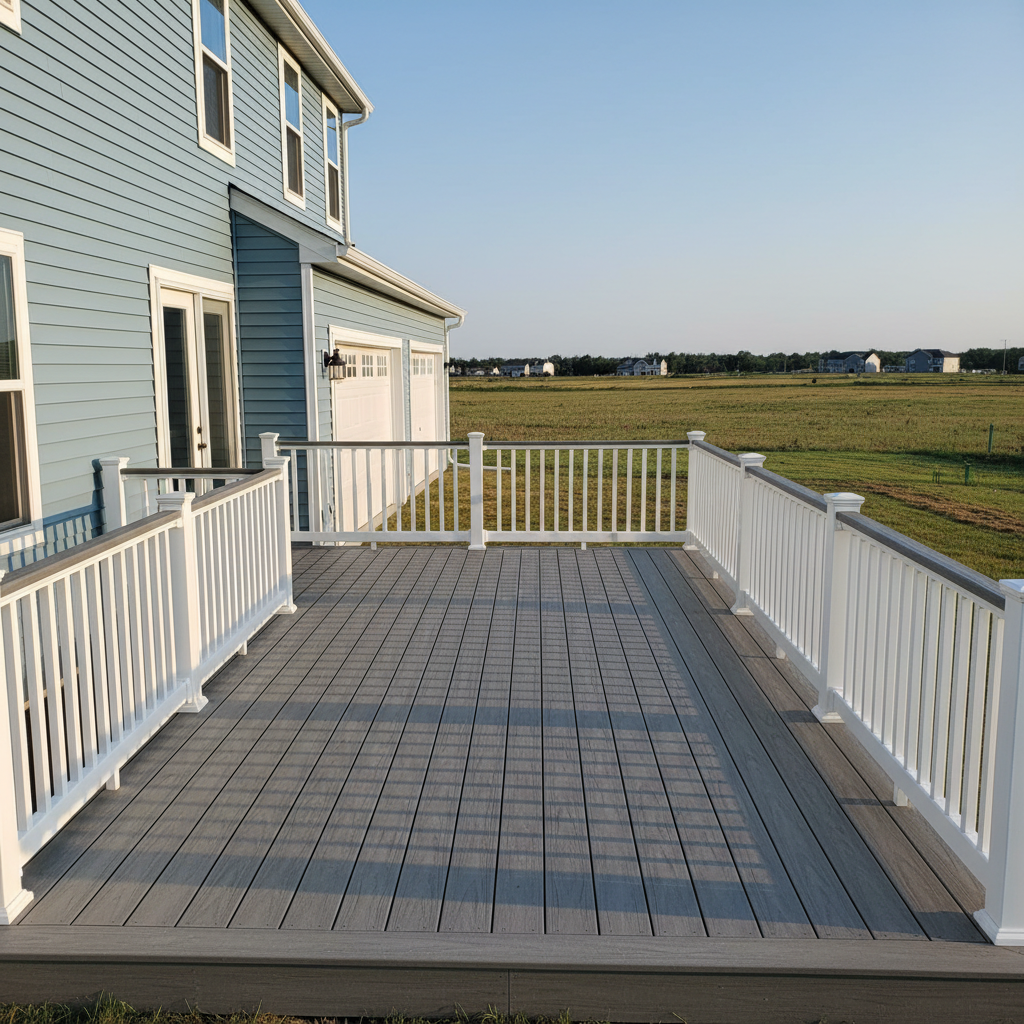
A deck is one of the few home projects where the part you never see decides whether the part you do see lasts. Anyone can lay down composite boards and make it look sharp for a photo. Whether it's still square and solid in eight winters comes down to the footings, the ledger attachment, and the joist spacing, none of which show up in the finished picture. So before you pick a builder on price or on how nice their last job looked, it helps to know what you're actually buying.
Why Evanston's ground and winters matter here
Cook County requires footings below the frost line, which runs about 42 inches down in this area. That's not a suggestion. Evanston soil is mostly heavy clay, and clay holds water and swells when it freezes. A footing poured at 24 inches might hold a deck up fine through a mild winter and then heave two inches the next one, enough to rack a railing or pop a board loose at the ledger. Any builder working here should know the frost depth cold, without looking it up in front of you. If they're talking about pouring shallow sonotubes to save a day of digging, that's your answer right there.
The lake adds its own problem: humidity. Evanston sits right on Lake Michigan, and that moisture doesn't just mean rust on fasteners, it means wood movement. Pressure-treated lumber swells and shrinks more here than it would inland, which is part of why gaps between boards and the spacing at butt joints need to be planned for, not eyeballed.
What the permit process actually looks like
Most deck work in Evanston needs a building permit through the city, and for anything attached to the house or more than 30 inches off grade, expect at least two inspections: one for the footings before you pour, one for the framing before the decking goes down. If your deck sits anywhere near a property line, a builder worth hiring will check the setback before digging, not after the inspector flags it. Evanston also has a lot of older lots with rear alleys, and alley-facing decks sometimes have different clearance rules than a deck facing the street. A contractor who shrugs when you ask about permits either doesn't pull them, which means the work isn't inspected, or expects you to pull them yourself and take the liability. Neither is a good sign.
Older houses change the job
A lot of Evanston's housing stock, especially around the Ridge, Dempster-Main, and the areas closer to downtown, went up between 1900 and the 1920s. These are balloon-frame or early platform-frame houses, and the rim joist you're supposed to bolt a ledger board into might be sistered, rotted, or not there at all behind the siding. A builder who's done this kind of work will pull the siding back and look before quoting the ledger attachment, not after signing the contract. On a newer build in west Evanston or Skokie, the rim joist is predictable engineered lumber and this is rarely an issue. On an older street it's often the single biggest unknown in the whole project, and it's worth asking directly: how are you attaching to my house, and have you opened up the wall to check what's back there?
Questions worth asking before you sign anything
- How deep are the footings going, and is that based on Cook County's frost depth or just a standard they use everywhere?
- Are they using stainless or hot-dip galvanized fasteners, given how much moisture this area sees? Standard coated screws corrode faster near the lake.
- What's the joist spacing for the decking you're choosing? Composite generally needs 12 inches on center, not the 16 inches that's fine for a lot of wood decking. A builder who frames at 16 inches for composite because that's what they always do will leave you with a bouncy deck.
- Who pulls the permit, and are they listing themselves as the contractor of record?
- What's the plan for the ledger board on an older house, specifically?
If the answers are vague, or if the quote is a single lump sum with no breakdown of footings, framing, decking, and railing separately, ask again. A real quote separates those because they're different materials bought at different times.
What to walk away from
A price that's dramatically lower than two others usually means something's getting skipped, and it's almost always the footings or the fasteners, since those are invisible once the job's done. Be wary of anyone who wants full payment up front before any material shows up. A deposit for materials is normal. Paying the whole job before a single post hole is dug is not. Walk away from anyone who can't tell you how many inspections the job needs, because that usually means they're not planning to call for them. And if a builder tells you frost footings don't matter much in this area, that's not a shortcut, that's a company that hasn't had a deck heave on them yet. Give it a few winters.
Getting a few quotes that actually compare
The easiest way to tell builders apart is to ask all of them the same specific question and see who gives you a real answer instead of a reassurance. Ask about footing depth. Ask about the ledger. Ask what happens if they open the wall and find rot. The ones who answer in specifics have done this before on a street like yours. We walk through all of this with homeowners before any contract gets signed, and you can see the range of work we do, from framing repair to full custom builds, over at Brookfield Deck Solutions.